How to Teach Handwriting to a 4-Year-Old: A Gentle 5-Step Plan

Here is how to teach handwriting in five gentle steps: build a comfortable pencil grip, practice the pre-writing shapes (lines, circles, and crosses), trace letters with guide lines, then write independently, keeping every session short and playful. Move to the next step only when your child is ready, not by a calendar.
TL;DR
- Teach handwriting in five steps: grip, shapes, tracing, independent writing, short sessions.
- Readiness is about skills, not a child’s exact age.
- Each step has a deeper guide; this page is the map.
- Guided tracing on lined paper bridges shapes and real writing.
- A few playful minutes a day beats one long, frustrating session.
Teaching a young child to write can feel like a big job, but it is really just a sequence done in order. There is no single right age, and readiness varies from child to child. Most children are ready somewhere between ages 4 and 6, and the goal is to follow the steps, not the calendar.
This page is the map. Each of the five steps below links to a deeper guide, so you can start here and go as deep as you need.
When should a child start learning handwriting?
There is no single right age to start handwriting. Most children are ready between ages 4 and 6, but readiness depends on skills, not birthdays: pre-writing shapes often emerge around ages 3 to 4, and letters follow once a child can hold a crayon, copy simple lines, and show interest in making marks. Pushing too early tends to backfire.
The calendar is the wrong tool here. A child who is interested and able at 4 is ready, and a child who needs until 6 is also perfectly normal.
What does handwriting readiness look like?
Handwriting readiness looks like a handful of skills coming together: your child can hold a crayon with some control, copy simple shapes like a line and a circle, shows interest in letters or their own name, and can sit for a few minutes. You do not need all of these at once, just a few of them.
◆ VERIFIED: Children can typically copy a cross and a square between ages 4 and 5, and hand dominance is usually established around age 5. Source: North Shore Pediatric Therapy
Hand dominance is usually set around age 5, and most children can copy a cross and a square between ages 4 and 5 [4]. For the full version, run through our handwriting readiness checklist, which takes about two minutes.
How do you build a comfortable pencil grip?
Step 1 is a comfortable pencil grip. Aim for the tripod grip, where the pencil is pinched between the thumb and index finger and rests on the middle finger, about an inch from the tip. Short crayons and broken chalk naturally encourage the right pinch, because there is no room left for extra fingers.
Keep this step low-pressure. A relaxed three-finger hold matters far more than a perfect-looking one, and our deep guide to how to hold a pencil covers the grasp stages and simple fixes.
How do children master the pre-writing shapes?
Step 2 is the pre-writing shapes, the strokes that build every letter. In rough order, children master the vertical line, horizontal line, circle, cross, square, diagonal lines, X, and triangle. These are the building blocks of letters: lines build E and T, the circle builds O and C, and diagonals build A and K.
According to GriffinOT, a pediatric occupational therapy resource, the average age for a shape is the age at which half of children can draw it, which is why readiness matters more than the calendar [1].
Master the shapes before pushing letters, and letter formation gets much smoother. The full sequence and quick activities are in our guide to pre-writing skills.
Why trace letters before writing them freely?
Step 3 is guided tracing, and it comes before free writing for a reason. Tracing builds muscle memory and teaches correct letter shape, size, and placement before a child has to recall a letter from memory. A dotted midline and a solid baseline give the hand a target, which is where a structured practice book first earns its place.
Guided tracing works best with a clear start point, so a child does not learn to form letters from the wrong place [2]. Our trace-then-write book is built around that, and the deeper logic of when to switch is in our guide to tracing vs free writing.
Want a free way to start tracing today? Our Activity Pages for Toddlers, 26 tracing pages plus 26 coloring pages, cost nothing.
How do you move from tracing to independent writing?
Step 4 is the bridge to independent writing. Fade the guides gradually: move from full dotted letters, to a few start dots, to a blank line with just the baseline. Start with your child’s name and favorite words, and expect a few stumbles like reversing b and d, which are completely normal at this age.
A common stumble here is flipping letters, so our guide to letter reversals explains why it happens and what helps. The same bound book carries a child from guided tracing straight into blank rows. One parent, Tamie, shared that her son “now writes his name nine times a day and his handwriting is improving.”
How long should handwriting practice be?
Step 5 is the easiest to get wrong: keep every session short. A few focused minutes a day beats one long weekly session, because young hands tire quickly and stay motivated when practice feels like play. Praise effort over neatness, and always stop before frustration sets in.
Little and often is the whole secret. Five good minutes today, then five more tomorrow, will outrun any marathon session.
What does a simple week-by-week rhythm look like?
A simple week-by-week rhythm is a guide, not a deadline. A relaxed order might spend the first weeks on grip and shapes, the next on guided tracing, and then ease into independent writing, always moving up only when your child is ready. Treat it as a loose map, not a schedule to enforce.
| Rough timing | Focus | What it looks like |
|---|---|---|
| Weeks 1 to 2 | Grip and shapes | Short crayons, drawing lines, circles, and crosses |
| Weeks 3 to 5 | Guided tracing | Tracing letters on a dotted midline and baseline |
| Weeks 6 and on | Independent writing | Fading the dots, starting with the child’s name |
Some children move faster and some slower, and both are normal. The order is what matters, not the weeks.
What do you need to get started?
To get started you need very little: a comfortable pencil or a short crayon, lined practice paper or a bound practice book, and a few minutes a day. The one choice that really matters is structure, because letters learned in a sensible order stick better than letters practiced at random.
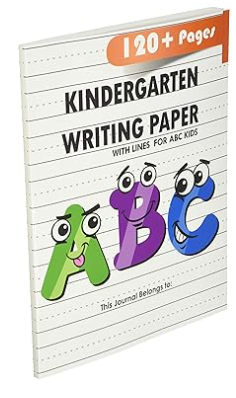
This is where a real bound book beats a stack of loose printables that get lost, crumpled, and arrive in no order. We compare a workbook and free printables side by side if you want the honest case both ways. Our kindergarten writing book is cover-bound, 122 pages, 8.5 by 11 inches, on thick no-bleed paper, rated 4.8 from 12,478 families. It keeps the whole journey in one place.
What do parents ask about teaching handwriting?
Below are the questions parents ask most about teaching handwriting, with short answers. They cover the step-by-step order, the 5 S’s of neat writing, the Montessori method, the right age to start, how long to practice, and whether to teach uppercase or lowercase first.
How do you teach handwriting step by step?
Teach it in order: build a comfortable pencil grip, practice the pre-writing shapes, trace letters with guide lines, then write independently. Keep each session short and playful, and only move to the next step when your child shows they are ready.
What are the 5 S’s of handwriting?
The 5 S’s are a memory aid for the qualities of neat handwriting. A common version is Size, Shape, Spacing, Slant, and Smoothness, which describe letters of a consistent size and shape, even spacing, a steady slant, and smooth lines. Some versions swap in Speed, but the idea is the same.
What is the Montessori method of handwriting?
The Montessori method builds writing through the senses first. Children trace textured sandpaper letters with two fingers, feeling the shape and hearing the letter’s sound, before they ever pick up a pencil. The idea is that the hand and senses learn the letter before the pencil does [3].
What age should a child start handwriting?
Many children begin pre-writing shapes around ages 3 to 4 and start forming letters around 4 to 6. Readiness matters more than age: look for interest in mark-making and the ability to copy simple lines and circles before pushing letters.
How long should handwriting practice be for a 4 year old?
Keep it short. A few focused minutes a day is more effective than one long session, because young hands tire quickly and stay motivated when practice feels like play. Stop before frustration sets in.
Should my child learn uppercase or lowercase first?
Uppercase letters are often taught first because they use simpler straight lines and circles and are easier for little hands. Many practice books include both, so a child can move from uppercase to lowercase at their own pace.
Sources and references
- “Pre-Writing Shapes: What Are They and How to Teach Them?” GriffinOT. https://www.griffinot.com/pre-writing-shapes-what-are-they-and-how-to-teach-them/
- “Letter Formation Activities and Tools That Work.” The OT Toolbox. https://www.theottoolbox.com/letter-formation/
- “Indirect Preparations for Handwriting.” Association Montessori Internationale. https://montessori-ami.org/trainingvoices/indirect-preparations-handwriting
- “Developmental Milestones for Pre-Writing and Writing Skills.” North Shore Pediatric Therapy. https://www.nspt4kids.com/parenting/developmental-milestones-pre-writing-writing-skills
Written by Smith John, founder of Tiny Writers Co and author of “Kindergarten Writing Paper with Lines for ABC Kids.” This guide is general education, not medical advice. Developmental details come from the named occupational therapy sources above. If you have concerns about your child’s development, speak with a teacher, pediatrician, or pediatric occupational therapist.
Ready for daily practice?
Our bound handwriting book gives 122 pages of trace-then-write practice for ages 4 to 6. Rated 4.8 by 12,478 families.