Letter Reversals (b/d, p/q): Why They Happen and What Helps
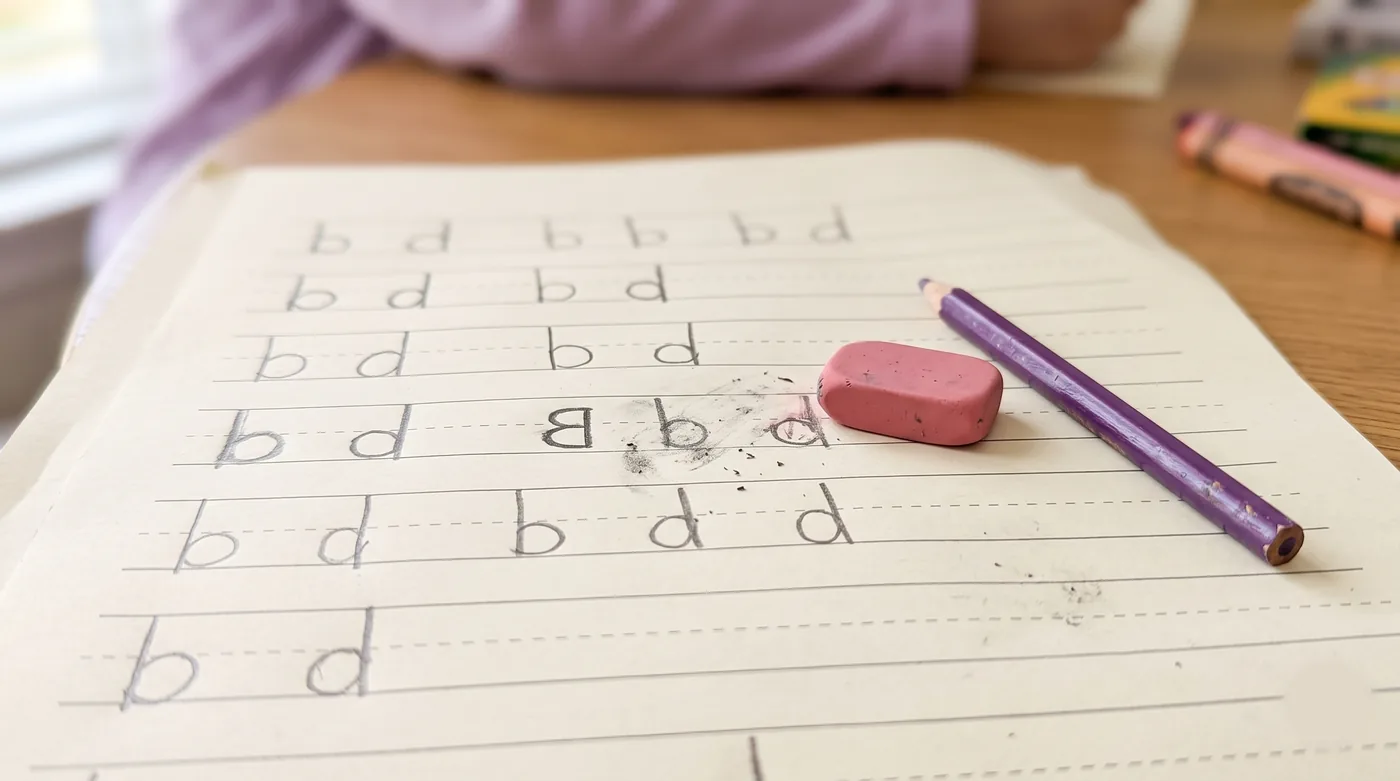
Letter reversals, like flipping b and d, are a normal part of learning to write and stay common up until about second grade, or age 7. On their own they are usually not a sign of dyslexia, but a sign that a young child is still learning that direction changes a letter. Consistent practice and a few simple tricks help them fade.
TL;DR
- Reversing b and d is a normal stage, common up until about age 7.
- On its own, a reversal is usually not a sign of dyslexia.
- Kids flip b, d, p, and q because they are mirror images of each other.
- The most reliable fix is practicing the same correct letter formation every time.
- If frequent reversals continue past age 7, mention it to your child’s teacher.
First, breathe. If your child keeps writing b for d, you are not watching a problem, you are watching a normal stage of learning. Nearly every new writer flips these letters for a while.
This guide explains why it happens, how long it usually lasts, what the dyslexia question really is, and the simple tricks that help most. The tone here is calm on purpose, because calm is what the research supports.
Is it normal for kids to reverse b and d?
Yes, reversing b and d is a normal, expected stage of early writing. Most children flip some letters as they learn, and b, d, p, and q are the most common because they are mirror images of one another. Reversals are typical up until about second grade and usually fade on their own as reading and writing practice grows [1].
◆ VERIFIED: Reversing letters is a normal developmental stage and, on its own, usually not a sign of dyslexia. Source: Understood.org, FAQs about reversing letters and dyslexia
So if your kindergartner writes a backward b half the time, that is squarely within the normal range. It is a sign the brain is still sorting out direction, not a sign that something is wrong.
Why do kids reverse b and d (and p and q)?
Kids reverse b and d because the letters are mirror images: the same circle-and-stick shape facing opposite directions. Direction is a brand new idea for a young child, because in their world a cup is still a cup whichever way it faces. When letter formation is still settling, flips are easy to make and nothing to worry about.
Letters are the first time a child meets something where direction changes the meaning entirely. That is a genuinely hard concept, and it takes practice to lock in.
The same logic explains p and q. Once a child firmly knows how each letter starts and moves, the flips fade.
How long are letter reversals normal?
Letter reversals are typically normal up until about age 7, and sometimes age 8, and they usually fade as reading and writing practice grows. According to The OT Toolbox, by age seven, and at the latest age eight, children should be reversing letters infrequently or not at all. Frequent reversals well past that age are worth a closer look [2].
The key word is frequent. An occasional flip in a tired seven year old is very different from constant, every-word reversals that are not improving.
If you are tracking it, look at the trend over a few months rather than any single worksheet.
Are letter reversals a sign of dyslexia?
On their own, letter reversals are usually not a sign of dyslexia. As the nonprofit Understood explains, reversing letters or mirror writing is not necessarily a sign of dyslexia, and most kids who reverse letters before age 7 do not turn out to have it [1]. Dyslexia involves broader reading difficulty, not just flipped letters.
This is the fear under most searches, so it is worth saying plainly. A reversed b is not a diagnosis.
Reversals become worth a closer look only when they persist past the typical age and come with other signs, such as trouble learning letter sounds, rhyming, or reading. If that describes your child, a calm conversation with their teacher is the right next step, not alarm.
What helps fix b and d reversals?
What helps most is practicing each letter the same correct way every time, plus a few simple multisensory tricks. The bed hand trick, air writing, tracing letters in sand or shaving cream, and saying each letter’s path out loud all give the brain an extra cue. Consistent letter formation is the strongest long-term fix [2].
| Trick | How to do it |
|---|---|
| The “bed” trick | Make two thumbs-up fists, knuckles together. The left hand is b, the right hand is d, spelling b-e-d. If your hands do not spell bed, the letter is flipped. |
| Write the word “bed” | Show that b starts the word and d ends it, with the bed frame sitting between them. |
| Air writing | Trace giant letters in the air while saying the formation out loud. |
| Textured tracing | Trace letters in sand, salt, or shaving cream so the hand remembers the motion. |
| Verbal cues | Say the path as it is written, for example, “b: line down, then bump out to the front.” |
The single most reliable fix is the least flashy one: practicing the correct formation until it becomes automatic. Teaching letters in the right formation order, capitals before the look-alike lowercase, heads off much of the b and d confusion. This is where structured tracing earns its keep. One parent, RM, shared that her pre-K daughter’s occupational therapist suggested home practice, adding that it “helps her focus on letter structure and spacing.”
That is exactly what our bound handwriting book is built around: a dotted midline plus solid baseline, trace then write, so the correct motion is repeated the same way every time, across 122 pages for ages 4 to 6. A sequenced book makes that consistency far easier than a random pile of printable sheets. To build the hand underneath it, see our guide to pre-writing shapes, and check that the pencil grip is comfortable first. The whole approach sits inside our gentle plan for teaching handwriting.
When should you ask for help?
You should ask for help if reversals are still frequent well past age 7, or by the end of second grade, especially alongside trouble with reading, rhyming, or remembering letter sounds. In that case, mention it to your child’s teacher or ask about an evaluation. For most kids, time and consistent practice are all it takes [1].
There is no harm in asking early if you are worried. A teacher sees hundreds of young writers and can tell you quickly whether what you are seeing is typical.
Trust your instincts, but hold the worry loosely.
What do parents ask about letter reversals?
Below are the questions parents ask most about b and d reversals, with short, reassuring answers. They cover how to fix reversals, how long they stay normal, why kids flip these letters in the first place, and whether reversals point to dyslexia.
How do you fix b and d reversals?
Practice each letter the same correct way every time, and add multisensory tricks. Use the “bed” hand trick, trace letters in sand or shaving cream, air-write big letters, and say each letter’s path out loud. Consistent, structured letter-formation practice is the most reliable long-term fix.
How long is it normal to reverse b and d?
Reversing b and d is normal up until about age 7, and sometimes age 8. Most children flip these letters while learning because they are mirror images, and it fades with reading and writing practice. If frequent reversals continue well past age 7, mention it to your child’s teacher.
Why do kids reverse b and d?
Kids reverse b and d because the letters are mirror images, the same circle-and-stick shape facing opposite directions. Young children are still learning that direction can change a letter’s meaning, and their letter formation is still developing, so flips are easy and expected at this stage.
Are b and d reversals a sign of dyslexia?
Usually not on their own, since reversing b and d is a normal developmental stage that most children grow out of. Dyslexia involves broader reading difficulties, not just flipped letters. Reversals are worth checking only if they persist past the typical age alongside other reading struggles.
Sources and references
- “FAQs about reversing letters, writing letters backwards, and dyslexia.” Understood.org. https://www.understood.org/en/articles/faqs-about-reversing-letters-writing-letters-backwards-and-dyslexia
- “Multi-Sensory Strategies for B and D Reversals.” The OT Toolbox. https://www.theottoolbox.com/multi-sensory-strategies-for-b-and-d-reversals/
Written by Smith John, founder of Tiny Writers Co and author of “Kindergarten Writing Paper with Lines for ABC Kids.” This guide is general education, not medical or diagnostic advice. Developmental details come from the named sources above. If you are concerned about your child’s reading or writing, speak with their teacher or a qualified specialist.
Ready for daily practice?
Our bound handwriting book gives 122 pages of trace-then-write practice for ages 4 to 6. Rated 4.8 by 12,478 families.