Pre-Writing Skills: The 9 Shapes Kids Master Before Letters
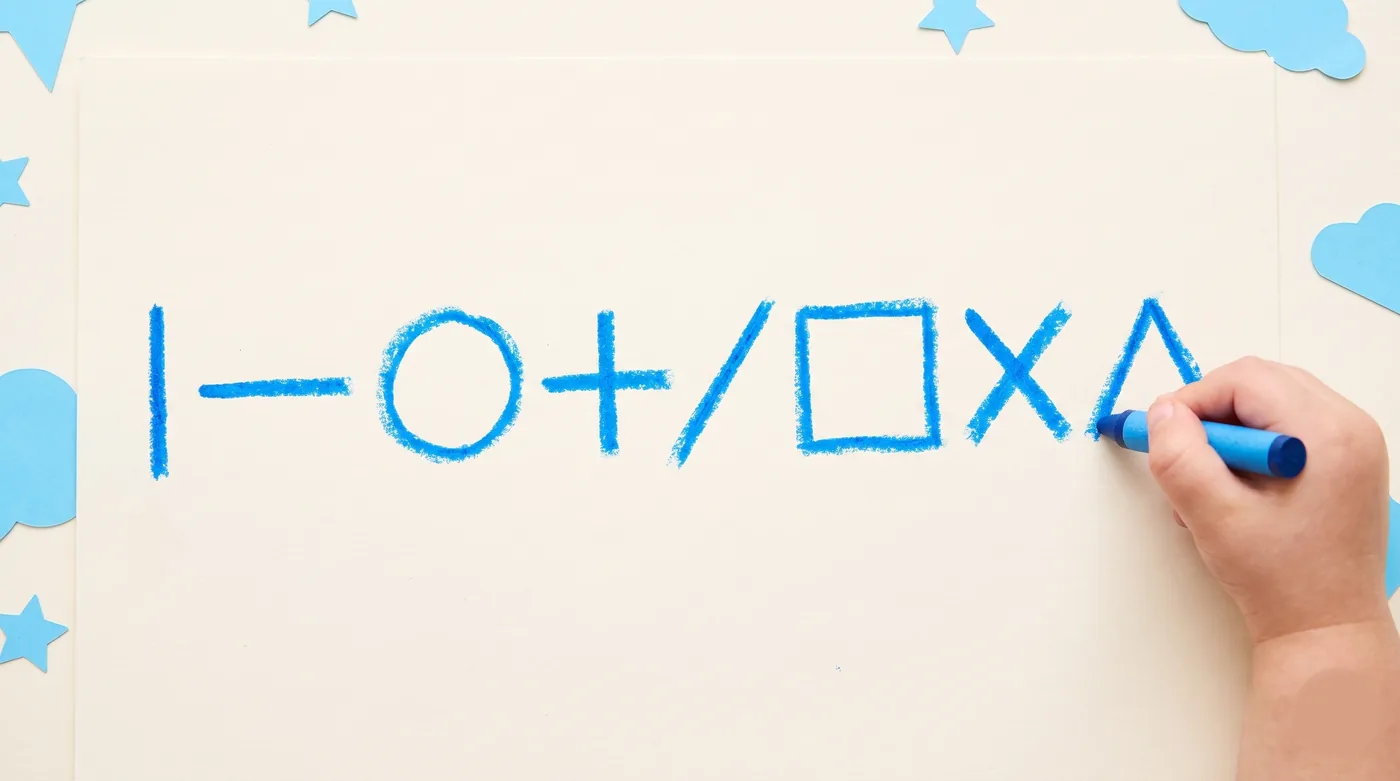
Pre-writing skills are the hand movements and shapes a child masters before forming letters. The nine pre-writing shapes, learned roughly in order, are the vertical line, horizontal line, circle, cross, square, left diagonal, right diagonal, X, and triangle. Drawing these confidently, with strong fine motor control, signals a child is ready to trace letters.
TL;DR
- Pre-writing skills are the shapes and hand control a child builds before writing letters.
- The nine pre-writing shapes run from the vertical line to the triangle, simplest first.
- These shapes are the building blocks of letters: lines build E and T, circles build O and C.
- Fine motor play like playdough and tongs builds the hand before the pencil.
- When a child can draw a circle and a cross, guided letter tracing is the next step.
If a teacher has mentioned pre-writing skills, or your four year old keeps drawing loops instead of letters, this is the map. Letters do not come first. A predictable set of shapes does, and they arrive in a reliable order.
This guide covers what pre-writing skills are, the nine shapes in sequence, why they matter, the hand strength behind them, and quick activities you can try at the kitchen table today.
What are pre-writing skills?
Pre-writing skills are the foundational hand movements and shape-drawing a child develops before writing actual letters. They include holding a crayon, controlling a line, and copying simple shapes like circles and crosses. Most children build these between ages 2 and 6, with the earliest strokes appearing in toddlerhood and the harder shapes arriving closer to kindergarten.
Think of pre-writing skills as the warm-up a hand needs before the main event. A child scribbles, then draws lines, then closes those lines into circles and corners, and each stage trains the small muscles that letter formation later depends on.
The point is not to rush. Readiness here is about skill, not birthday.
What are the 9 pre-writing shapes, in order?
The nine pre-writing shapes, in the order most children master them, are the vertical line, horizontal line, circle, cross, square, left diagonal line, right diagonal line, X, and triangle. The simplest strokes come first, around ages 2 to 3, and the diagonals and the triangle come last, closer to age 5, because they are the hardest to control.
◆ VERIFIED: The shape sequence and ages below come from pediatric occupational therapy guidance, not opinion. Source: GriffinOT, Pre-Writing Shapes
| Order | Shape | Typical age mastered | Letters it helps build |
|---|---|---|---|
| 1 | Vertical line | around age 3 | E, F, H, L, T |
| 2 | Horizontal line | around age 3 | E, F, H, L, T |
| 3 | Circle | around age 3 | O, C, Q, G |
| 4 | Cross (+) | around age 4 | t, plus signs |
| 5 | Square | age 4 to 4.5 | corners and box letters |
| 6 | Left diagonal | around age 4.5 | A, K, M, N |
| 7 | Right diagonal | around age 4.5 | A, K, M, N |
| 8 | X | around age 5 | X, Y |
| 9 | Triangle | around age 5 | A, and any corner shape |
The ages are guides, not deadlines. As GriffinOT, a pediatric occupational therapy resource, puts it, “the average age is the age at which 50% of children will be able to draw the shape,” which is exactly why readiness matters more than the calendar [2]. Heather Greutman, a Certified Occupational Therapy Assistant, describes the same sequence, noting that pre-writing lines begin as baby scribbles and grow into lines, circles, and shapes over time [1].
Here is the one line worth keeping: these shapes are the building blocks of letters. The vertical and horizontal lines build E, F, H, L, and T, the circle builds O, C, and Q, and the diagonals build A, K, V, W, and X.
A child who can draw the parts can usually be taught the whole.
Why do pre-writing shapes come before letters?
Pre-writing shapes come before letters because every letter is just a combination of these strokes. A child who cannot yet draw a clean circle or a steady diagonal will struggle to form O, A, or K, and that struggle often turns into frustration or sloppy habits. Mastering the shapes first makes letter formation smoother.
Picture it from the child’s side. Asking a four year old to write a capital A before they can draw two diagonals and a cross is like asking them to run before they can balance.
When the shapes are solid, letters stop feeling like new information and start feeling like familiar parts clicked together.
What fine motor skills does writing need?
Writing needs fine motor skills: the small, precise hand and finger movements that control a pencil. These include finger strength, a pincer grasp between the thumb and index finger, and hand-eye coordination. They develop through everyday play, not worksheets, which is why the strongest pre-writing practice often looks a lot like fun.
A child simply cannot draw what their hand is too weak or too uncoordinated to steer.
The encouraging part is that you build these skills by playing. Squeezing, pinching, threading, and tearing all train the same muscles a pencil uses, long before a pencil is ever involved.
What are 5 quick pre-writing activities to try at home?
Five quick pre-writing activities that build the hand are rolling and pinching playdough, moving pom-poms with tongs, threading beads, tearing paper, and peeling and placing stickers. Each one strengthens the fingers and the pincer grasp a child needs to draw shapes and, later, to form letters. None of them looks like a worksheet, which is the point.
- Playdough. Rolling, pinching, and squishing build hand and finger strength.
- Tongs or tweezers. Moving pom-poms or dry cereal trains the pincer grasp.
- Threading beads. Builds precision and two-hand teamwork.
- Tearing paper. Strengthens fingers and control, and kids love the mess.
- Stickers. Peeling and placing builds fine control, and it is genuinely fun.
Aim for a few playful minutes, not a long session. Want ready-made practice once your child is keen to start? Our free Activity Pages for Toddlers, 26 tracing pages and 26 coloring pages, are a no-cost way to begin.
When is a child ready to move from shapes to letters?
A child is usually ready to move from shapes to letters once they can draw the core strokes, especially the vertical line, the horizontal line, the circle, and the cross. At that point, guided letter tracing is the natural next step, where the child copies the correct letter motion before writing it alone, rather than facing a blank page. Our guide on what order to teach letters shows which letters to start with.
If you are not sure where your child sits, our handwriting readiness checklist walks through the signs in two minutes. Grip matters here too, so it is worth a look at how to hold a pencil before formal practice begins. For the whole journey from shapes to first words, follow our step-by-step plan for teaching writing.
When the shapes are ready and the grip is comfortable, structured tracing is what turns practice into progress. That is exactly what our bound handwriting book is built for: a dotted midline plus solid baseline, trace then write, thick paper that does not bleed, 122 pages for ages 4 to 6, rated 4.8 from 12,478 families. A real sequenced book gives the hand a target, which a random stack of printable sheets rarely does, and the right practice paper matters as much as the book here.
What do parents ask about pre-writing skills?
Below are the questions parents and teachers ask most about pre-writing skills, with short answers you can use today. They cover the simple pre-writing progression, easy exercises, a plain example, and the fine motor skills that sit underneath all of it.
What are the 5 steps of pre-writing?
A simple pre-writing progression has five steps: build hand strength through play, learn to grip a crayon or pencil, scribble freely for control, copy basic shapes like lines and circles, then trace and form letters. Each step rests on the one before it, so the order matters more than the speed.
What are 5 prewriting exercises?
Five easy prewriting exercises are rolling and pinching playdough, picking up small objects with tongs or tweezers, threading beads, tearing paper, and peeling and placing stickers. Each one strengthens the fingers and the hand control a child needs to draw shapes and, later, to write letters.
What is pre-writing with an example?
Pre-writing is everything a child does to get ready to write before forming actual letters. An example is a four year old drawing a circle and a cross. Those two shapes are the building blocks of letters like O, C, T, and E, so practicing them is preparing the hand to write.
What are fine motor skills for writing?
Fine motor skills for writing are the small, precise hand and finger movements that control a pencil, such as a pincer grasp, finger strength, and hand-eye coordination. They develop through play like playdough, threading, and using tongs, and they make letter formation far easier when the time comes.
Sources and references
- Heather Greutman, COTA. “Pre-Writing Skills Checklist for Kids.” Growing Hands-On Kids. https://www.growinghandsonkids.com/pre-writing-skills-checklist-kids.html
- “Pre-Writing Shapes: What Are They and How to Teach Them?” GriffinOT. https://www.griffinot.com/pre-writing-shapes-what-are-they-and-how-to-teach-them/
Written by Smith John, founder of Tiny Writers Co and author of “Kindergarten Writing Paper with Lines for ABC Kids.” This guide is general education, not medical advice. Developmental details come from the named occupational therapy sources above. If you have concerns about your child’s development, speak with a teacher, pediatrician, or pediatric occupational therapist.
Ready for daily practice?
Our bound handwriting book gives 122 pages of trace-then-write practice for ages 4 to 6. Rated 4.8 by 12,478 families.