Is Your Child Ready to Write? A Handwriting Readiness Checklist

Handwriting readiness is a cluster of skills, not a birthday. A child is usually ready to write when they can hold a pencil in a tripod-style grip, draw basic pre-writing shapes, copy a circle and a cross, show a clear hand preference, control a crayon without tiring, sit and focus for a few minutes, and show interest in letters. Readiness varies, so late starters are normal.
TL;DR
- Handwriting readiness is about skills, not a child’s exact age.
- The 7 signs run from a tripod grip to a genuine interest in letters.
- Most signs settle into place between ages 4 and 6.
- Not all 7 boxes need to be perfect before you start gentle practice.
- If your child is not ready, build the foundations through play, not pressure.
Every parent eventually asks the same quiet question: is my child ready to write yet? The honest answer is that a birthday will not tell you, but a short list of skills will.
Run through the seven signs below. If most are there, it is a good time to start gentle, guided practice, and our gentle 5-step handwriting plan lays out the order to follow. If they are not, that is fine too, and this guide covers exactly what to do instead.
When should a child start writing?
There is no single right age to start writing. Readiness usually appears between ages 4 and 6, but it varies widely from child to child, because it depends on skills rather than birthdays. Pushing a child before they are ready can cause frustration and poor habits, so it is better to wait for the signs than to watch the calendar.
◆ VERIFIED: Hand dominance is typically established around age 5, and children can usually copy a cross and a square between ages 4 and 5. Source: North Shore Pediatric Therapy, Pre-Writing and Writing Milestones
Writing readiness is about what the hand and brain can do, not about a number. Two children the same age can be months apart, and both can be perfectly normal.
What is the 7-point handwriting readiness checklist?
The seven signs of handwriting readiness are a tripod-style pencil grip, drawing pre-writing shapes, copying a circle and a cross, a clear hand preference, enough finger strength, the focus to sit for a few minutes, and an interest in letters. Not all seven need to be perfect to begin.
| # | Readiness sign | What it looks like |
|---|---|---|
| 1 | Tripod-style pencil grip | Holds a crayon with the thumb and first two fingers, not a full fist |
| 2 | Draws pre-writing shapes | Makes lines, a circle, and a cross, the building blocks of letters |
| 3 | Copies a circle and a cross | Reproduces each shape when shown one, so the hand can follow a model |
| 4 | Clear hand preference | Reaches with the same hand consistently, a sign dominance is settling |
| 5 | Enough finger strength | Controls a crayon or pencil without tiring quickly |
| 6 | Can sit and attend | Stays with a table activity for a few minutes |
| 7 | Interest in letters or name | Asks about letters, tries to “write,” or recognizes their own name |
Most of these signs settle into place between ages 4 and 6. Hand dominance, for example, is typically established around age 5, and children can usually copy a cross and a square between ages 4 and 5 [2]. A mature, tripod-style grip tends to arrive in that same window [1].
A soft rule of thumb: if most boxes are ticked, it is a good time to start. Perfection is not the bar.
What if my child is not ready yet?
If your child is not ready yet, that is completely normal and not a problem. The best move is not to force letters, but to build the foundations through play: keep working on pre-writing shapes, hand strength, and a comfortable grip. Readiness almost always arrives with time and low-pressure practice.
Forcing the issue tends to backfire, because a frustrated child learns to dislike the pencil.
The smarter path is to keep things playful. Strengthen the hand with our guide to pre-writing shapes, and make sure the pencil grip is comfortable before any formal practice starts. The skills will come.
How do you start once your child is ready?
Once the boxes are mostly ticked, start small with guided tracing rather than blank-page writing, so your child copies the correct letter motion before doing it alone. Our guide on when to move from tracing to free writing shows how to fade the guides. Short, daily sessions beat long ones. Lined paper with a clear baseline and a dotted midline gives the hand a target to aim for, and the best handwriting practice paper has exactly that.
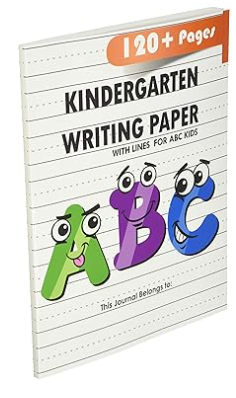
This is the natural first step, and it is exactly what our bound handwriting book is made for: dotted midline plus solid baseline, trace then write, uppercase and lowercase, picture-word pages, and free-draw space, for ages 4 to 6. One parent, Amanda, summed it up simply: “Simple, straightforward, and great to help my kindergartener write. The sizing is just right.”
A real sequenced book gives that structured first step, which a loose stack of printables cannot. Want to try before you buy? Our free Activity Pages for Toddlers, 26 tracing pages plus 26 coloring pages, are a gentle place to begin.
What do parents ask about handwriting readiness?
Below are the questions parents ask most about when a child is ready to write, with short, reassuring answers. They cover what a kindergartner should be able to write, what a five year old’s handwriting realistically looks like, and the age most children begin forming letters.
What should a kindergartener be able to write?
Many kindergartners can write their own first name, most uppercase letters, and some lowercase letters, often with uneven sizing and a few reversals. Letters may not sit neatly on the line yet, and that is normal. Kindergarten is when letter formation is actively being learned, not mastered.
What should a 5 year old’s handwriting look like?
A five year old’s handwriting is usually large, uneven, and still developing. Letters may vary in size, sit above or below the line, and include some reversals like b and d. With consistent, guided practice, letter size and spacing improve steadily over time.
At what age should a child be able to write?
Most children begin writing letters between ages 4 and 6, but readiness depends on skills, not age. A child is ready when they can grip a pencil, draw basic shapes, and show interest in letters. Some are ready earlier and some later, and both are perfectly normal.
Sources and references
- “Is Your Child Ready for Handwriting? Try These OT Tips.” Small Talk Speech and Occupational Therapy. https://smalltalkspeech.com/occupational-therapy/handwriting-readiness/
- “Developmental Milestones for Pre-Writing and Writing Skills.” North Shore Pediatric Therapy. https://www.nspt4kids.com/parenting/developmental-milestones-pre-writing-writing-skills
Written by Smith John, founder of Tiny Writers Co and author of “Kindergarten Writing Paper with Lines for ABC Kids.” This guide is general education, not medical advice. Developmental details come from the named occupational therapy sources above. If you have concerns about your child’s development, speak with a teacher, pediatrician, or pediatric occupational therapist.
Ready for daily practice?
Our bound handwriting book gives 122 pages of trace-then-write practice for ages 4 to 6. Rated 4.8 by 12,478 families.