Free Kindergarten Writing Paper: 5 Printable Lined Paper PDFs
This free kindergarten writing paper comes in five printable PDFs: large, standard and smaller lines, a landscape page and story paper with a picture box. Every row has a solid top line, a dotted midline and a red baseline, sized to match classroom handwriting paper. They print on US Letter with no sign-up.
Free for home and classroom use. Print at actual size (100%) on US Letter paper.
Choose a sheet
-
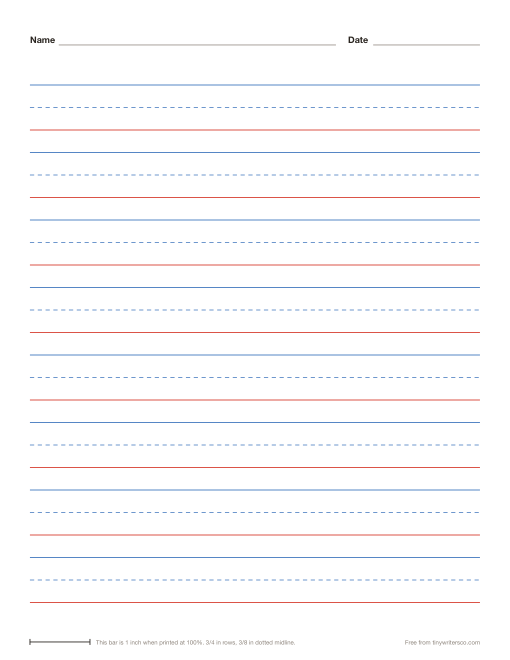 Standard lines 3/4 inch rows Most kindergartners PDF ↓
-
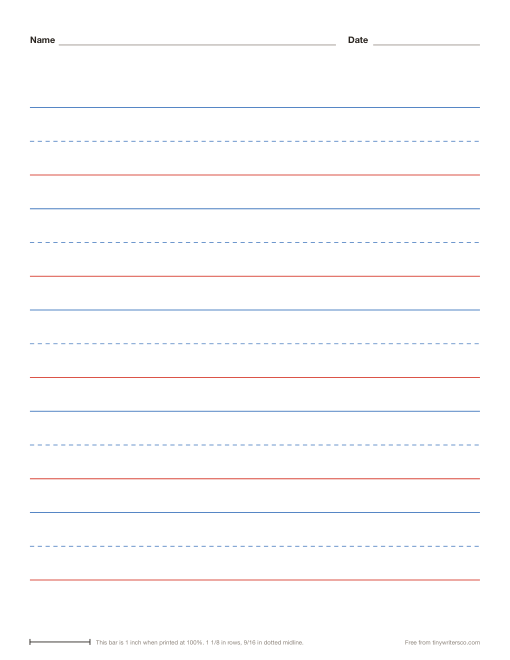 Large lines 1 1/8 inch rows Pre-K and early K PDF ↓
-
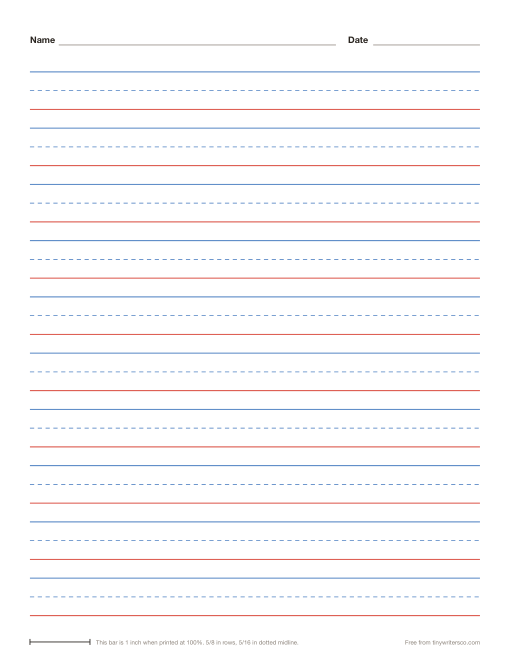 Smaller lines 5/8 inch rows Late K and grade 1 PDF ↓
-
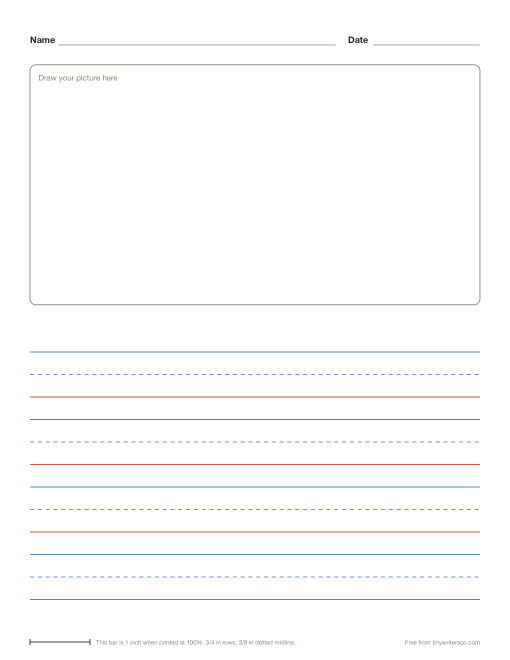 Story paper 3/4 inch rows + picture box Draw, then write PDF ↓
-
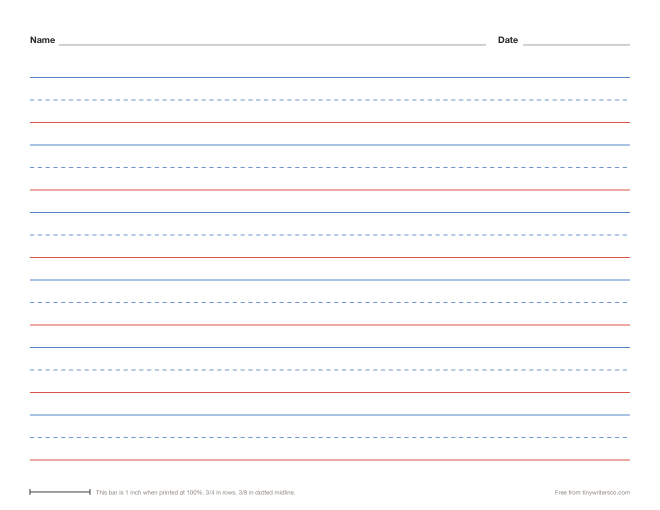 Landscape 3/4 inch rows, sideways Longer rows for names PDF ↓
Need another size, a title or A4? Make your own in the handwriting paper maker. Still learning letter shapes? Start with our free A to Z tracing sheets.
Which kindergarten writing paper size should you print?
For most kindergartners, print the standard sheet with 3/4 inch rows. Use the large 1 1/8 inch sheet for pre-K or the first weeks of kindergarten, when letters are still big and wobbly. Switch to the 5/8 inch sheet once your child’s letters fit easily between the lines.
These are not sizes we picked by eye. Each one copies a ruling that Pacon, a large US maker of school paper, lists in its ruled paper guide for a named handwriting program and grade [1]. Here is what each sheet uses and where the size comes from.
| Sheet | Row height (top line to baseline) | Dotted midline | Gap between rows | Rows per page | Same ruling as |
|---|---|---|---|---|---|
| Large lines | 1 1/8 inch | 9/16 inch | 9/16 inch | 5 | Zaner-Bloser paper for pre-K and K [1] |
| Standard lines | 3/4 inch | 3/8 inch | 3/8 inch | 8 | Zaner-Bloser paper for K [1] |
| Smaller lines | 5/8 inch | 5/16 inch | 5/16 inch | 10 | D’Nealian paper for K and Zaner-Bloser paper for grade 1 [1] |
| Landscape | 3/4 inch | 3/8 inch | 3/8 inch | 6 | Standard lines, turned sideways |
| Story paper | 3/4 inch | 3/8 inch | 3/8 inch | 4, under a picture box | Standard lines with room to draw |
Zaner-Bloser and D’Nealian are handwriting programs many US schools use. We are not linked to either. If your child’s class uses a different program, ask the teacher which paper they write on and pick the closest line size here.
What do the three lines on kindergarten paper mean?
Most kindergarten handwriting paper uses the same three lines. The top line shows how tall capital letters and tall letters like b, d and h should be. The dotted midline shows where small letters like a, e and o stop. The red baseline is where every letter sits, and tails on g, p and y hang below it.
In Pacon’s guide [1], the ruling is the distance from the top line to the baseline, and the midline number is the distance from the dotted line down to the baseline. The skip space is the empty gap before the next row starts, which keeps one row of tails from crashing into the next row of tall letters.
A simple way to teach it: the top line is the sky, the dotted line is the fence and the baseline is the grass. Small letters stay under the fence. Tall letters reach the sky.
How do you print the paper at the right size?
Always print at actual size. In the print window, choose “Actual size” or “100%” instead of “Fit to page”. Fit to page shrinks every row a little, and a 3/4 inch row can come out closer to 5/8 inch without you noticing.
Every sheet has a small bar at the bottom left that measures exactly 1 inch when printed correctly. Hold a ruler to it after your first print. If the bar is short, change the scale setting and print again.
We checked the files the same way. A script reads every line in each PDF and measures the row height, the midline and the gap between rows, and the build fails if any of them is off by more than 1/100 of an inch. All five sheets pass.
When should your child move to smaller lines?
Move down a size when your child’s small letters sit under the dotted line and their tall letters stop at the top line on most of a row. Letters that keep bursting through the top line mean the row is too small for now. Letters that float in the middle of a big row mean it is time to go smaller.
Bigger is not always kinder. A parent who reviewed our book on Amazon wrote that “too-big spaces actually make her handwriting sloppier.” Large rows suit a child still learning the shapes. Once the shapes are there, a snug row teaches size control.
Most children move from the large to the standard sheet during kindergarten and to smaller lines near the end of the year or in first grade, which matches the grade order in Pacon’s guide [1]. Go by your child’s letters, not the calendar.
Should you print sheets or buy a writing paper book?
Print the free sheets to find the right line size and for the odd homework page. For daily practice, a bound book is cheaper per page and keeps every page in one place. Home printing costs roughly 5 to 10 cents a page in black and white once ink and paper are counted, according to Toner Buzz [2].
| Printing these sheets at home | Our writing paper book | |
|---|---|---|
| Pages | As many as you print | 120 blank practice pages |
| Cost | Roughly 5 to 10 cents a page [2] | $9.99 for the paperback |
| Lines | Your choice of three sizes | Solid top line, dotted midline and solid baseline on every row |
| Pages stay together | No, loose sheets | Yes, bound with a glossy cover |
| Best for | Trying sizes, homework, one-off pages | A page a day for the whole school year |
That is why we made Kindergarten Writing Paper with Lines for ABC Kids: 120 blank pages of three-line rows in one 8.5 by 11 inch book, with no tracing letters, so your child writes on their own. It is rated 4.8 stars from 12,487 ratings on Amazon. If your child still needs letters to trace first, start with our free A to Z handwriting practice sheets.
Questions parents ask
Is the kindergarten lined paper really free?
Yes. All five printable sheets are free to download and print for home or classroom use, with no email sign-up. You can download each sheet on its own or all five in one PDF and print as many copies as you need.
Can I print the sheets on A4 paper?
The sheets are made for US Letter, 8.5 by 11 inches. A4 is a little narrower and taller, so print at actual size and check the 1-inch bar. The rows keep their size, though some printers may trim the very ends of the lines near the side edges.
Will the lines show up in black and white?
Yes. The blue and red lines print as two shades of gray, and the midline stays dotted, so your child can still tell the three lines apart. Color helps young writers find the baseline, so use color when you can.
What is the box on the story paper for?
Your child draws a picture in the box first, then writes a word or sentence about it on the lines below. Drawing first gives a beginning writer something to say. Many kindergarten classes call this a journal or picture story page.
Can teachers copy these sheets for a class?
Yes. Teachers can print and copy them for their own students. Please link to this page rather than uploading the files elsewhere, so families always get the current version.
What should my child write on the paper?
Start with their first name, then the letters they are learning this week, then short words. If you are not sure which letters come first, our guide to what order to teach letters gives a full sequence, and our guide to how to teach a child to write covers the whole path from grip to sentences.
Sources and references
- Pacon Corporation. “Ruled Paper Guide.” https://pacon.com/files/pacon_content/Miscellaneous%20Images/Ruled%20Paper%20Guide_r07-21-16_low.pdf
- “Printing Costs: How to Accurately Calculate Your Printing Cost Per Page.” Toner Buzz. https://www.tonerbuzz.com/blog/printing-costs/
Written by Smith John, founder of Tiny Writers Co and author of “Kindergarten Writing Paper with Lines for ABC Kids.” Zaner-Bloser and D’Nealian are trademarks of their owners. This guide is general information for parents and teachers. If you have concerns about your child’s handwriting, speak with their teacher or a pediatric occupational therapist.
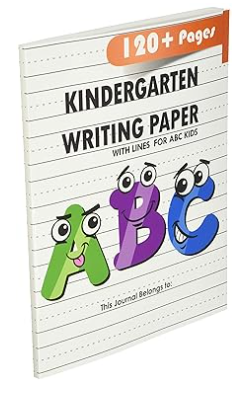
A page a day, without the printer
120 blank pages of three-line rows, bound in one 8.5 by 11 inch book. No tracing letters, so your child writes on their own. Rated 4.8 from 12,487 ratings.